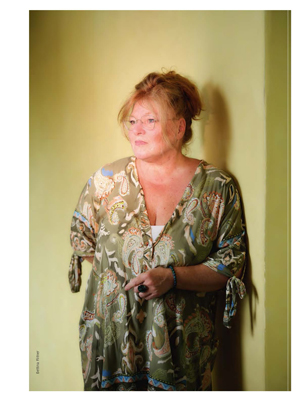
Schwarzer: "The Adventure of my life"

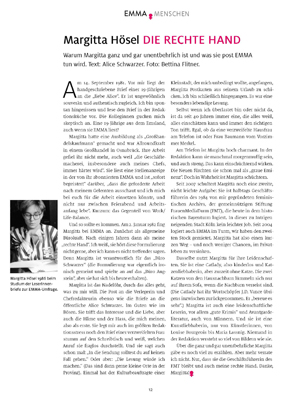
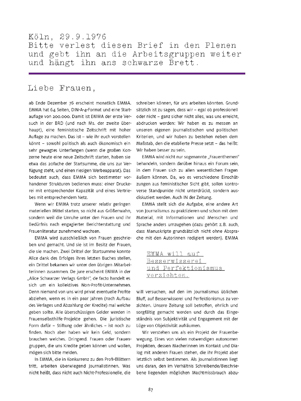
It was a moment of great pride: when the printing presses started whirring and the very first issue of EMMA rolled off the press onto a wide strip of paper. The event was featured on the daily news on across all TV-channels and all the national newspapers reported on it. I got off the train in Cologne with the first hot-off-the-press copies of EMMA, hastily assembled by the printers. Three women were waiting for me on the platform.
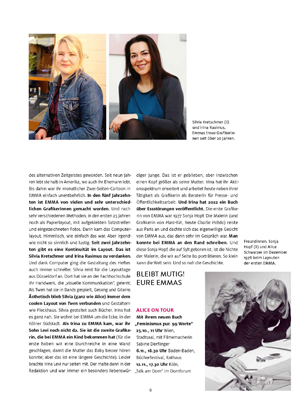
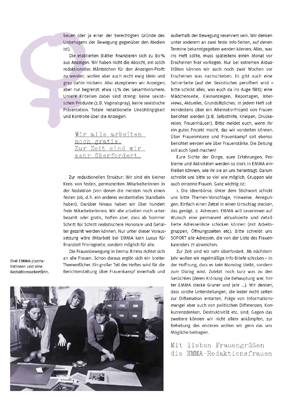
They were a mixed bunch. Two journalists and one editorial secretary. One was an ‘after-work’ EMMA. She contributed ideas and topics, but she never gave up her job as an television editor and would come to the EMMA office in the evenings, which was practically opposite of the WDR broadcasting house and which rooms were still half-empty. The second resigned from her job at the Kölner Stadtanzeiger after a few months and became an EMMA editor. The third, the secretary, wasn’t really one. She was a technical draughtswoman who had been retrained. She could not find a job because her sister was in the RAF (the Red Army Faction, an extreme left-wing terrorist organization). I had hired her in protest against this sort of family liability and collective punishment.
And me? I was already an experienced journalist at the time, but I had never produced a magazine before. For the foundation of EMMA I had moved from Paris and Berlin to Cologne, the media city, and was now sitting in the still empty premises I had just rented at Kolpingplatz 1 a. That is where I worked and also lived in one room on the roof terrasse. If back then in January 1977 someone had told me that I would be running EMMA for the next five years, it would have filled me with joy. If someone had told me that I would be publishing EMMA for the next 50 years – I would have been running away screaming.
Because this wasn’t my intention: to be a publisher and editor for life. I was after all an author who wrote articles for magazines, produced features for radio, occasionally made a contribution to television. And I had just published my first three books with Suhrkamp and Fischer. The first one in 1971 about women’s fight against the ban on abortion, the second one about women’s work in jobs and family, most recently the scandalous bestseller “Der kleine Unterschied” (The Little Difference – and his great consequences) about the oppressive function of love and sexuality in our society.
So how did I come to initiate EMMA? It was the misogyny of the ‘men’s media’, how we feminists used to call them, that led me to conclude that we female journalists needed our own publication, our own voice. And it was the fact that one woman had already done so successfully: Gloria Steinem, (she died recently). In New York, the first issue of Ms. had appeared in January 1971 initially only as a supplement to New York Magazine. I had met Steinem in Paris in 1973; she hadn’t exactly encouraged me (“Nobody will give you any money”). Which turned out to be true. But at least: Ms. existed. So, it was feasible.
The story of how EMMA came into being was a turbulent one; it can be read in my autobiography (and seen in the rather authentic feature TV-film “Alice” from 2022). I took my money from my book “Der kleine Unterschied”, which was 250,000 mark. Margarete Mitscherlich (the renowned psychoanalyst) gave me a loan of 10,000 mark (and was very surprised when she got it back at the end of 1977 with 10 percent interest). And there was also money from the future subscribers. This came from subscription cards in the “Frauenkalender” (Women’s Calender), which I was producing yearly at the time with some friends. That did‘t amount to much, because most women’s bookshops had removed these cards from the calendar and thrown them away. I did not realize that until much later though. Yes, that’s how it all began.
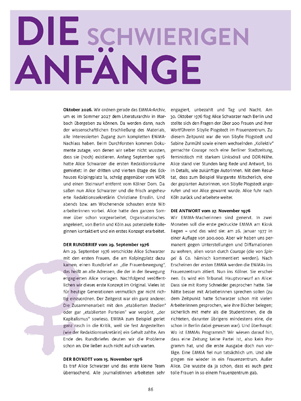
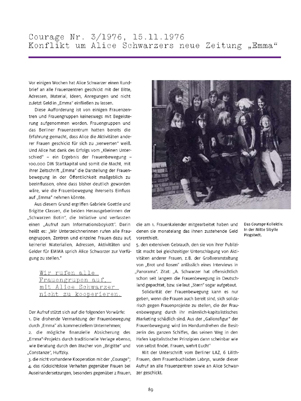
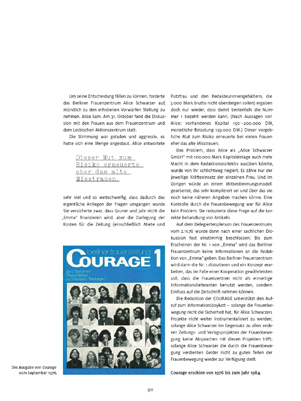
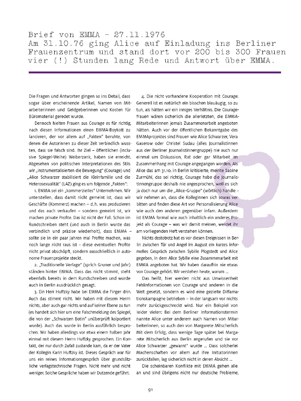
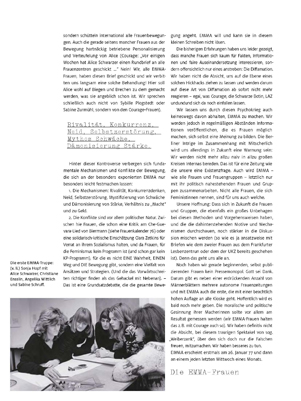
In Courage, a feminist magazine in Berlin, initially published locally but went nationally at the same time as EMMA, a call for boycott against EMMA had in fact been published even before the first appearance of EMMA. To this day, I still haven’t really a clue why. I had not in the slightest expected that this publication from within the movement - which had started out as stapled-together leaflets – would see EMMA, a declared journalistic project, as competition. On the contrary.
But presumably, alongside jealousy and rivalry, it was probably the political differences that continue to smolder to this day: between left-wing feminists (Courage) and universalist autonomous feminists.
All that happened a very long time ago. Personally, during my first few years at EMMA, it weighed heavily on my heart and made my work very difficult – extremely difficult even. And some of it still resonates in fact to this day.
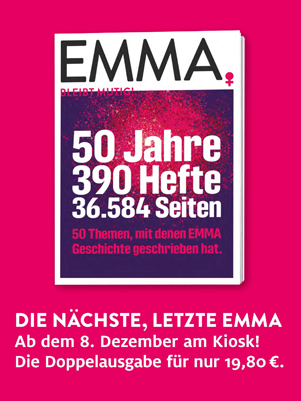
In the first ten years I had to learn all on my own how to put the paper together and how to be the boss. It wasn’t just negotiating with printers – which was actually the easiest part – it was running a team. And all this at a time when the Zeitgeist was about running a project as a “collective”; yet the work, the responsibility and the risks almost always fell on individuals in the end. The same was true at EMMA. And there were’n just internal problems; from outside I also had the full force of the mainstream media against me. The mockery and also the envy of the colleagues (men and women alike) were tremendous. It was predicted that no more than two issues of EMMA would be published. In the end, there were 390 issues.
After a year, the first EMMA “collective” – which had never actually been one – fell apart. The external pressure on “the men-haters”, combined with internal tensions, proved to be too much.
In the mid-1980s I wanted to collectivize the ownership of the EMMA publishing house. That’s how things were done back then. Fortunately, two people talked me out of it. Two very different people. One was the publisher of the political magazine (k)Spiegel, the other an EMMA editor. When Rudolf Augstein visited the EMMA editorial office in 1987, he said to me: “Don’t make that mistake! I made it. The result is that now everyone has a say and no one wants to leave anymore.” In 1974 Augstein had handed over 50 percent of the publishing house’s shares to his staff.
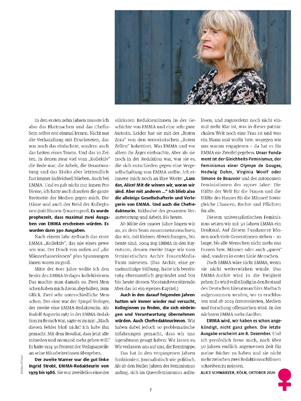
The second person was the quite left-wing Ingrid Strobl, an EMMA editor from 1979 to 1986. She was undoubtedly one of the strongest editors in EMMA’s history and a very good writer. Unfortunately, she flirted with the “Rote Zora” (a militant, radical-feminist underground organization) of the terrorist “Red Cells” (a group of terrorists from the far left). Which caused problems for EMMA and, above all, for her. But while she was still working in the editorial team, she was the one who firmly opposed the socialization of EMMA. I still remember her words: “Don’t do that, Alice! With you we know where we stand. But with others …” So, I remained the sole shareholder and publisher of EMMA. And also, the editor-in-chief. With all the responsibility and work that entailed. Right up to the present day.
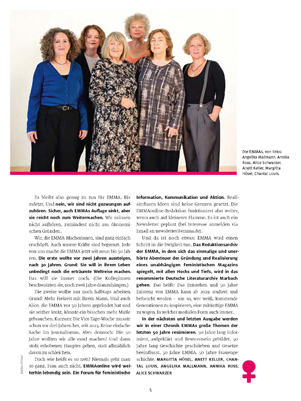
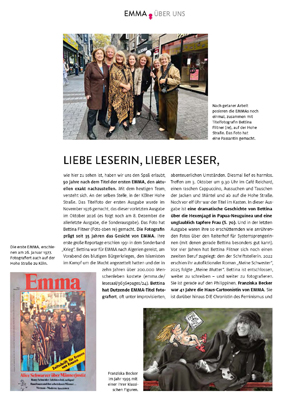
From the mid-1990s we started to grow into the team that we are today, with few minor changes. In 2004 EMMA moved into the Bayenturm (a medieval tower), we rented the second floor from the feminist archive FrauenMediaTurm. (I had already founded this archive back in 1984, a non-profit foundation, on a voluntary basis and have been its chair of the board to this day. But that is a story for another time.)
In the years that followed we kept trying from time to time to find colleagues who would contribute and take on responsibility – including editors-in-chief. However, our experiences in this regard were so problematic that at some point we decided to stop trying. Instead, we would rely on ourselves, the core team.
That has worked well in recent years – both journalistically and politically. Ever since the 2000s, when feminists began to dissolve into queer feminism and ultimately it is no longer even clear what constitutes a woman – or a man - in this patriarchal world; or what we should fight for or against and why – EMMA has never had any doubts. Our foundation is the equality-feminism, the feminism of Olympe de Gouges, Hedwig Dohm, Virginia Woolf or Simone de Beauvoir, and of the autonomous feminists of the 1970s: Half the world for women and half the household for men! As well as equal opportunities and the same rights and responsibilities for all.
We are paying tribute to this universalistic feminism with EMMA’s 50th anniversary-edition. On this basis many generations can continue to stand, until all people are no merely women and men or also “queer”, defined by their gender, but first and foremost human beings.
But EMMA wouldn’t be EMMA if it were not to continue its work. The EMMA archive will live on for eternity: It will become part of the permanent inventory of the German Literature Archive in Marbach, where it will be catalogued and, starting 2029, made available without restriction to anyone interested, as well as to media and researchers. More about that in our next issue.
As we announced EMMA will not be ceasing publication entirely. The final print issue will be published on December 8th. And personally after 50 years I am looking forward to having enough time to devote to my books and don't have to squeeze writing them between two editorial deadlines.
ALICE SCHWARZER, Cologne, Oktober 2026